Archive
Newsletter Archive
July 18, 2026
Micro-lensing, finger-paint and columnar jointing.
Hello again!
I know it's a cliche to talk about the weather, but it's hot here again. That is all.
Now that my identity as British has been confirmed, on to the news. Work continues on the final Martians book, another few thousand words hitting the virtual page, and a very recognisable reference to the dangers of nuclear research. See if you can guess what it might be, answers on a postcard (or just by hitting reply).
My flow continues, the characters are continuing to go through new and horrible challenges, and the fate of humanity really does hang in the balance. I've been very happy with the writing recently, and hopefully that means less work for future-me when it comes to editing. Although now I might well have jinxed it...
In other writing news, I keep having ideas for more stories. Don't worry, I'm not letting them distract me. I write them down, keep them safe, and will come back to some of them once the current book is done. That serves two purposes: I don't get distracted, which is the main reason; and it gives them time to rest. That way when I do come back to them, they've had a chance to either mature into a real idea and spark enthusiasm, or reveal themselves as a flashy idea with no actual substance behind them. I'm averaging about 60/40 in favour of 'this idea has legs' at the moment, which means I already have more ideas than I can usefully expect to write about. I think it'll be a host of short stories, and if any of them really take off then perhaps they can stretch into novels...
What do you do with your ideas, when you don't have time to think about them? Write them down? Trust that if they're good enough, you'll remember? Or drop everything and chase after the new hotness? I know which I would do if I wasn't disciplined...
Space News
NASA's TESS mission finds a planetary system in a new way
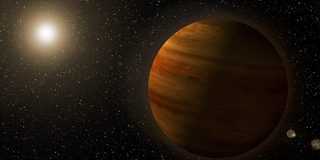
I must admit something. I'm old enough that I remember a time when we didn't even know for sure that there were exoplanets. The first one was suspected to exist in 1988, and the first confirmation had to wait until 1992. Obviously scientists were sure they had to exist; the odds of our solar system being the only one in the universe were so small as to be impossible, but it's not that long ago that we couldn't be sure.
Early detections used the dimming of stars as giant planets passed them, or tiny shifts in the star's position. Later we were able to directly image a few, or detect them via gravitational lensing, and since then we've managed some spectroscopy of their atmospheres and some truly remarkable science.
Now we can add 'ripples in space-time' to the list.
NASA's TESS (Transiting Exoplanet Survey Satellite) has spotted planet Gaia23bra b due to a once-only alignment of a distant star with the nearer planet and its own star, bending the light just right for us to spot it. As its name suggests, it is meant to look for planets passing in front of their own stars and dimming them, which is especially effective at finding massive planets extremely close to their stars. This one was much further out, so transit methods would not work. In this case, microlensing revealed the existence of the planet.
There's a great animation in the article that demonstrates this, but in short the foreground star lensed the light of a distant star, and the planet added just enough twinkle for us to realise there's something there.
Now you might be wondering about the name - and yes, the Gaia space telescope spotted it, but was unable to prove it was indeed a planet.
“Gaia’s observations were too sparse to pick up on the planet,” said Mallory Harris, a Ph.D. candidate at the University of New Mexico, who led the study. “The TESS spacecraft happened to be monitoring the same area of the sky during the event, and its denser time coverage showed extra features in the light curve caused by a planet.”
So while Gaia spotted an anomalous brightening, it took TESS to confirm what they were actually seeing.
Source: NASA
Book Recommendations
Fantasy
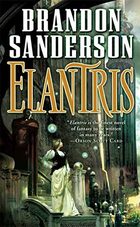
Elantris
I'm late to Brandon Sanderson. Anyone who reads fantasy has known about him forever, but as primarily a Sci-Fi fan at the time he came on the scene I must have just missed the hype.
This is his first book, and he only gets better from here. But that's not to say this is bad! The characters are incredible, the pace is terrific (by the third chapter we've already had a prince cast into exile, his bride-to-be kept in the dark and preparations for a holy war put in motion) and the magic system is inventive and remarkably well-explained without massive information dumps.
Ten years ago, without warning, the magic failed.
For centuries, Elantris was a shining beacon of magical creativity and wonder. The magic selected from the population at random, granting people supreme power, glowing silver skin and a life of luxury. One day, it all collapsed. Now those chosen are shambling, leprous husks, closer to death than life, and the city is crumbling and rotting, slime filling the streets. When the crown prince is stricken with the curse, he is silently locked in the decaying city, and his death proclaimed.
Sci-Fi
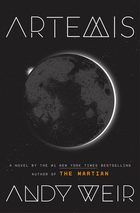
Artemis
Everyone knows The Martian and Project Hail Mary, not least because of their film adaptations, but anyone who hasn't read Artemis is missing out. Once again there's a capable protagonist, in this case Jazz, a rebellious petty criminal who gets dragged into a heist plot on the moon, now colonised and a popular tourist destination.
When you live on the moon, of course you have a dark side...
As you would expect, the science is front and centre, but the humanity (and inhumanity) of the moon's inhabitants is never far behind. Weir has clearly considered not only what it would take to live on the moon, but what it would do to you, and how you might or might not choose to obey the rules.
Don't overlook this one!
Strange News
Gower cave art confirmed as the oldest in the UK
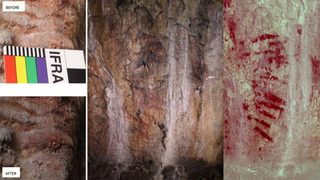
The wonderfully named Bacon Hole Cave, overlooking the Bristol Channel, has long been known for a painted rock panel and the extensive collection of animal bones inside showing occupation well back into the stone age. But the painted rocks were dismissed as natural staining, since they were composed of red iron oxide which occurs naturally in the area.
Recent research has shown that in fact it was the work of humans living in the area as far back as 17,100 years ago.
Predating all previously identified rock art sites in north-western Europe by at least 1,500 years, the intriguing artwork is a find of international significance.
They confirmed that the dabs of red paint, as ordinary as they may look, were definitely placed there by human fingers.
The cave was already listed as a Site of Special Scientific Interest, but this just bolsters that designation. Sadly it's too treacherous to allow public access, but at least that means we're preserving this fascinating art for the next generations.
Source: National Trust Cymru
Miscellany
- NASA's New Horizons spacecraft wakes from hibernation in good health
- Scientists make a new discovery in the history of the Giant's Causeway
- Archaeologists uncover an ancient Byzantine city in Egypt's western desert
Recent Reads
And Finally
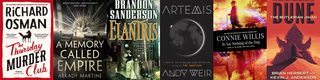
I'm nearing the end of Jerusalem by Alan Moore at the moment, and it's been quite the experience. I'll write more about it when I'm done, but 1200 pages of tiny text sent me crying to the Kindle version. I'm glad I did, the man is a literal wizard of language and does things with words I hadn't realised were even possible. If you only know him for his now-disavowed comic books, or (heaven forbid) the movies based on them, you are missing out. That said, it's not for the faint of heart. Wait for my more detailed and hopefully organised thoughts when I'm done.
I've also been listening to The Thursday Murder Club by Richard Osman. I find I can keep two very disparate books in my mind if one is read and one is listened to, and this has been a welcome palate cleanser after the dense, rich language of Jerusalem. While the plot is twisty-turny, the characters are a lot easier to understand and there isn't a chapter written as one long run-on sentence, or using words that sound like the ones the character means, but also evoke three layers of meaning that hint at greater depths. A straightforward murder mystery isn't my usual fare, but I did enjoy it, and the narrator did a great job.
So there you have it, a challenging literary cliff-edge of a book, or a cup-of-tea-and-a-biscuit-friendly murder mystery for you. Until next time...