Archive
Newsletter Archive
July 4, 2026
Methane, Crannogs and Giant Scorpions
I hope you survived the recent heatwave, or that your current locale has been saved from the worst of the weather. Even through the hottest of days, though, I did manage a few thousand more words on the latest book, although I've not looked back to see whether I've just written page after page of 'No water and no breeze makes Mark a hot boy.' I think we're OK though.
All joking aside, we broke any number of records during this one. Hottest day in June (three in a row). Hottest overnight temperatures in June. And not just in England, but Wales and Northern Ireland too. Only Scotland was spared, although it was still well above average for the time of year.
And we didn't even get a decent thunderstorm to wrap it all up! That's usually the consolation prize, that we get some dramatic storms and lightning after the heat of the day. But apart from a few silent flashes at about 2am, we saw nothing. Although that's probably just as well, given how unreliable our power supply seems to be. We had a few wobbles now and then, and a transformer blew just down the road, but somehow we didn't lose our incredibly necessary fans.
So writing continues, we've had our first harvest of potatoes from the garden (we'll eat some tonight), and even a few strawberries that the pigeons haven't spotted. The crows have had all the redcurrants though, and they weren't even ripe. So much for them being smart... And a few tomatoes and peppers look almost ready to pick, so with any luck we'll be enjoying the fruits of our garden sooner rather than later.
On with the news...
Space News
3I/ATLAS contains 30 times more semi-heavy water than comets in our solar system
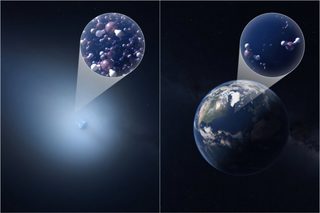
There's an interstellar comet called 3I/ATLAS which is currently past Jupiter and leaving the solar system at a phenomenal speed. Curiously it's only the third ever object (that we know of) which has come from outside our own solar system. Almost every comet we see, whether periodic or occasional, originates from the Oort Cloud, which although ridiculously distant is still 'local', as astronomers figure it.
So this one is pretty special. Formed around another star from the left-over dust and ice of the planetary system that must be there, it could tell us a lot about our neighbours. So scientists aimed the James Webb Space Telescope at it, and checked out its IR signature, along with using the Atacama Large Millimeter/submillimeter Array to look at its composition.
Previous visitors (Oumuamua in 2017 and 2I/Borisov in 2019) were either not displaying cometary behaviour at all or very dim, so they were hard to examine. 3I/ATLAS is shining bright in the infrared, so it gave us a fantastic insight into its make-up. The warmer it got, the more methane it emitted. Not to be outdone, the ALMA team discovered 30 times as much heavy water as 'local' comets do, something which is extremely unlikely to happen by chance.
Sources: Phys.org Heavy Water & Phys.org Methane
Book Recommendations
Fantasy

Maplecroft
Lizzie Borden was a real person, acquitted for the axe-murder of her parents in 1892. The case, and the notoriety which she was never able to shake, led to a folk rhyme that's still in circulation today:
Lizzie Borden took an axe
and gave her mother forty whacks.
When she saw what she had done,
she gave her father forty-one.
This book imagines the circumstances around the murder, using the court case and the facts available as just a starting point. What unfolds is a truly Lovecraftian nightmare, in which Lizzie is the only one capable of holding back the tide of incomprehensible horrors that took over her parents' bodies.
"The people of Fall River, Massachusetts, fear me. Perhaps rightfully so."
For all of H.P. Lovecraft's (many) failings, he captured the existential horror of knowing that there are things outside of our understanding that cannot be reasoned with, defied or even destroyed for good. This novel continues that trend, without the misogyny, racism and other traits that distract us from Lovecraft's work today.
Sci-Fi
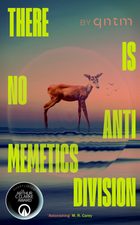
There Is No Antimemetics Division
How do you fight something you don't even remember encountering? We're all familiar with memes, ideas that stick in your head and move from mind to mind as if propagating themselves. The name was even coined as a counterpoint to 'gene', so similar is the idea. But if something gets lodged in your head, what is the opposite? Something you can't remember?
Doctor Who fans will be familiar with The Silence, a race of aliens who edit themselves out of your memory. As soon as you can't see one, you forget you ever knew about them. This book takes that, runs with it, hides it in the back of your nightmares and then reinvents it so you wouldn't recognise it even if you did remember it. That's an antimeme.
"An antimeme is an entity with self-censoring properties. Some are benign; but others, less so..."
We follow the erstwhile members of the Antimemetics Division, who can never be sure from day to day whether they've made any headway in a war they don't know about. Based on the SCP shared-continuity universe, this story is remarkable. We (the audience) learn along with the protagonists things that they should already have known, and it really draws you into the 'can I trust what I remember' paranoia that must come with fighting such threats.
There's even a short film version of the opening chapter.
Strange News
Archaeologists baffled by mysterious ancient 'island' at bottom of Scottish loch
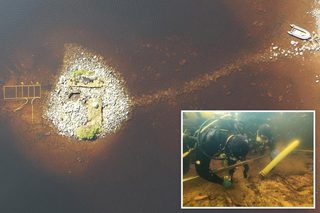
A crannog is a small, artificial island in a loch, typically thousands of years old. Now one in Loch Bhorgastail has been discovered to be built on top of a wooden foundation. The stone above was previously assumed to be piled there from the lake-bed by the Neolithic builders, and while wood has been known to be a part of the structure since its discovery, it's only recently that archaeologists discovered that the wooden structure actually supported the entire artificial island.
They're 'baffled', as headline writers love to say, by why this was done. The skills on display suggest it was probably quite commonplace across the Outer Hebrides, and in fact it went through periods of rebuilding from its simple wooden origins in around 5000BCE, through the complex structure that was placed around 3500BCE, before more stone and wood was added at points since then.
So why build so many, carefully designed and incredibly difficult to erect? The usual answer is 'ritual purposes', the typical response of an archaeologist who doesn't know any better, but it is a genuine mystery. They must have been important, enough to spend a lot of time and effort on, and using them as fishing spots hardly seems likely.
Source: BBC
Miscellany
- This improbable exoplanet system is so wonky because of a weird object within
- Ancient pregnant shellfish fossil reveals earliest-known evidence of maternal care
- World's largest scorpion had 6-inch pincers, and prowled UK land and waters 415 million years ago
Recent Reads

And Finally
A while back I entered a writing contest run by Cats Protection, and I just heard that I wasn't selected as a winner. Ah well, those are the breaks. But you can read the story anyway, right here on my website. I wonder if it was a little too fantastical for them? Let me know what you think, at any rate.
Lola, the cat that inspired it, has been loving the hot weather. We barely see her when it's above 20C, and breaching 30C means she basically went feral. She'd pop in now and then for some water, or to leave most of a vole on the doorstep, and then vanish again for hours. I'm sure she was just lying in the shade somewhere napping, but I like to believe she's off hopping through dimensions and having wild adventures. Remind me to tell you about my series I've planned around her sometime...