Archive
Newsletter Archive
May 9, 2026
Life, death and trumpets
Well, it's been a while, hasn't it? Last year was a bit of a mess, all things considered. But not to worry, I'm back, still writing, and still fascinated by the science and strangeness all around us. So I figured, it was more than overdue that I bring you some of my favourite stories of the past few weeks.
And a special welcome to those joining from the 'StoryBundle' promotion I was a part of earlier this year! Thanks for buying the bundle, signing up for the newsletter, and I'm sorry it's taken so long to hear from me.
For those who have been around a while, this newsletter might look a little different. I've moved providers, and so you should be getting a neater, cleaner and more reliable service in the future. If you have any issues with reading this, if something doesn't work or doesn't look right, do please let me know. You can just hit 'reply' to this email and it'll come straight to me.
Enough waffling, you're here for the news!
Space News
Curiosity finds most diverse organic molecules ever on Mars
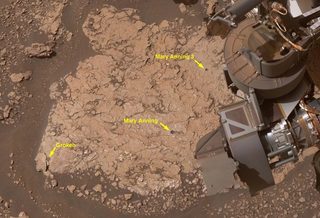
I still remember when there was debate over whether water had ever existed on Mars, something that's now completely accepted. We know it was there, it's still there, and now the debate has moved on to whether life ever existed. And some are adamant that it must still be present, although that's hardly anything more than faith at this point.
But a recent discovery is shedding more light on both possibilities. The Curiosity rover has found "the most diverse collection of organic molecules ever found on the Red Planet", according to NASA. And they're not just trying to grab headlines with some wooly science. The sample was taken and analysed in 2020, and it's taken until now for scientists to be confident enough in their findings to go public.
While the carbon-containing molecules are not themselves evidence of life (they could be formed by geological processes, after all), but they certainly suggest the right chemistry for life to form was indeed present on ancient Mars. The survival of delicate compounds for billions of years despite Mars' thin atmosphere adn exposure to radiation also offers hope that life might well have existed, or even survived.
In a handy bit of serendipity, the scientists named the sample after Mary Anning, the famous paleontologist we've mentioned in this newsletter before.
Personally I suspect we're going to get proof of 'life on mars' pretty soon, the only question is whether it'll still be around...
Source: Sky At Night Magazine
Book Recommendations

Piranesi
I read this earlier this year, and it absolutely mesmerised me. I can't give too much away in this review, but it was an absolutely unique read, captivating from start to finish. It's a mystery, a fantasy, possibly sci-fi, possibly something else entirely. From the synopsis:
Piranesi lives in the House. Perhaps he always has.
In his notebooks, day after day, he makes a clear and careful record of its wonders: the labyrinth of halls, the thousands upon thousands of statues, the tides that thunder up staircases, the clouds that move in slow procession through the upper halls. On Tuesdays and Fridays Piranesi sees his friend, the Other. At other times he brings tributes of food to the Dead. But mostly, he is alone.
Strange News
Boudicca's war trumpet unearthed
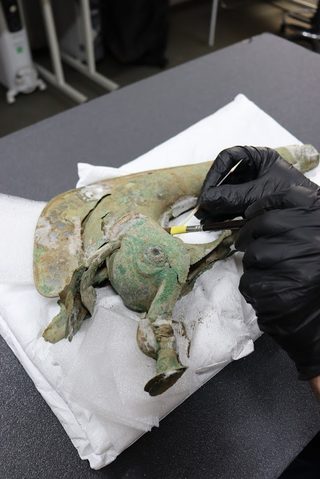
A rare Iron Age hoard has been discovered in Norfolk, during excavations before building new houses. This recent find includes a carnyx, an Iron-Age battle trumpet which is so rare that only three have been found in the UK. This new discovery is the best-preserved one found in Europe, so it's really remarkable. And yes, my headline is a little click-baity, we don't have any actual links to Boudicca (or Boadicea), it was used by the Celtic tribes to rally troops, and the Romans prized them as war trophies, so it's only a small exaggeration.
There were also other finds, including a boar's head made from sheets of bronze, which would have sat atop a military standard, and shield bosses (the metal centre of a wooden shield that would help deflect sword blows).
And there's also an unknown item made of iron. Let your imagination run wild.
Source: Historic England UK
Miscellany
- Giant ancient octopuses as apex predators — Fossil jaws suggest early octopuses were far larger and more fearsome
- The Iliad found inside an Egyptian mummy — Papyrus fragment with lines from the Catalogue of Ships found inside a mummy during Roman-era tomb excavation.
- A "fifth force" hiding in the solar system — NASA scientists note universe behaves differently at galactic vs solar system scales.
And Finally
We have another cat trying to move in. We've nicknamed him Charlie, since he's 'a right cheeky charlie'. He's wandered in through the catflap a few times, helped himself to some biscuits and even had a nose-to-nose chat with Lola, our current resident. Usually she's feisty enough to chase off any interlopers, and we've had a number of squabbles over the years, but they seem to be pretty friendly. He looks healthy and well-fed, so we're pretty sure he has a nice, safe, loving home, but he's clearly on the lookout for a new crash pad.
The only issue is, he's terrified of us. At the first sight or sound of use approaching, he bolts. We're obviously not keen on a food thief, but we don't mean any harm to him. It'd be good to get a picture, so we can ask around the neighbours whether he does indeed belong to someone as we believe.
And we've been calling him 'he' based purely on being bold enough to saunter in, but if we can't get close enough for a photo we certainly can't be sure he isn't actually a she...